

Each Measure Review: Sharon Katta
FEATURE
Before you read this article, do me a favor:
Go open up Spotify (or another music streaming app) and listen to Sharon Katta’s seven-minute EP Death Said, Breathe from start to finish. Then, after you’ve had a moment to process and reflect, come back and read the rest of my review.
Death Said, Breathe really is the kind of raw sonic journey that deserves space to speak for itself. I gave the EP a first listen before I’d even read Katta’s press release, with no prior knowledge of the artist or the intentions behind the release. That’s not my usual process, but in hindsight, I think it’s the best way to engage with a project like Death Said, Breathe. It allowed me to experience the work fully open-minded and free of expectations. Best of all, it allowed me to be caught off guard. I recommend you take the same approach.
Sharon Katta’s work exists at the intersection between music and performance art. The India-based artist began developing original music in 2018, later building his professional practice in London, and since then he’s developed a body of work that seems to defy all the typical cliches of genre. His past releases, which have been well received by Spotify audiences, include wholly unique tracks like “Home,” “Authority,” and “Detachment Theory.” While some of his tracks feature a more traditional sound than others, all of them offer an undercurrent of sonic experimentation, made possible by Katta’s expertise in the world of sound design.
Katta is a true maverick in the music industry, working under his own UK-registered record label, Faceless Fruit, Ltd. He personally takes charge of every aspect of his work, from the songwriting process to both the recording and production. It occurs to me that the reason he’s chosen to carve out such a fiercely independent niche for himself isn’t just because he has something new to say, but also because he recognizes that he’s the only one who knows how to say it.
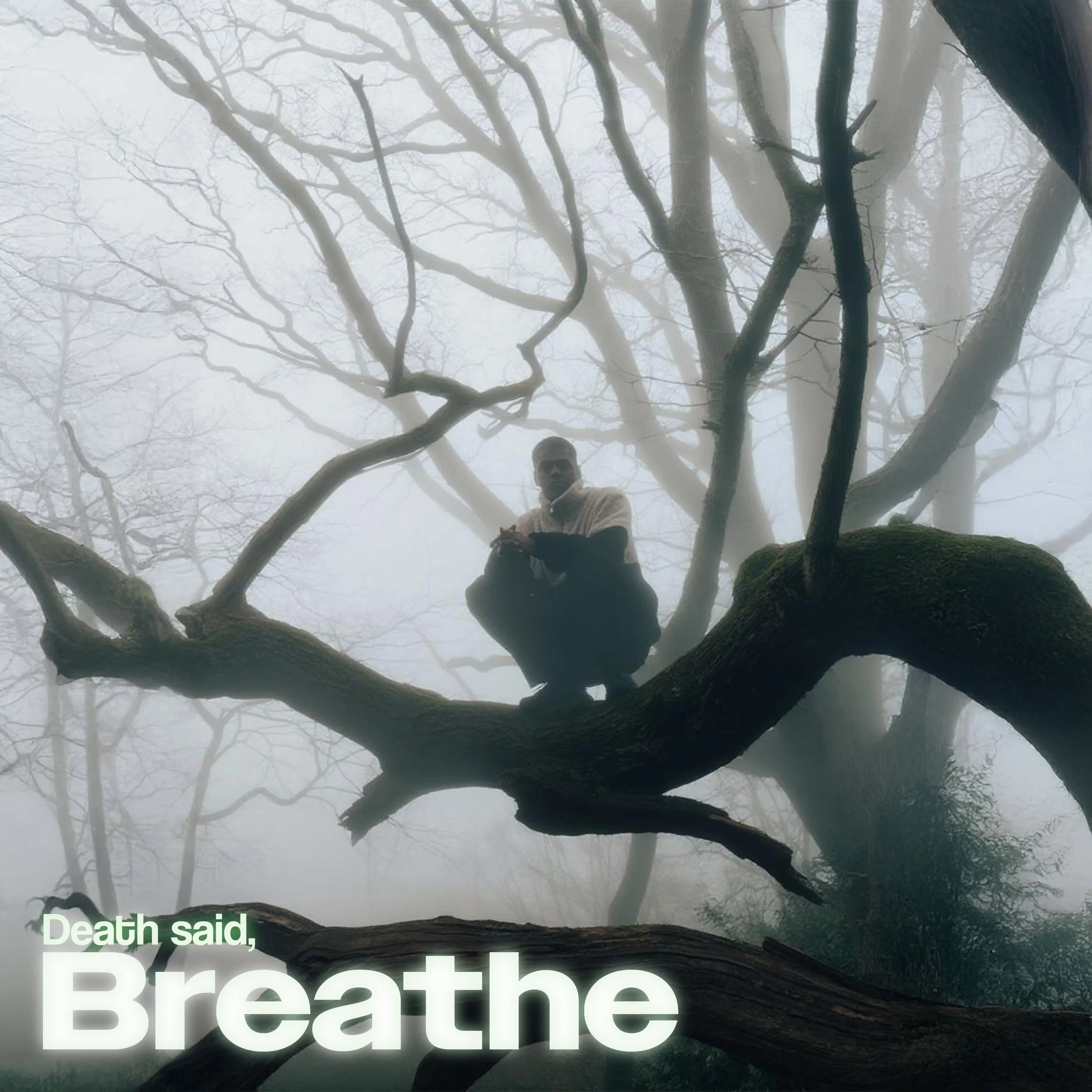
A story in three acts, Death Said, Breathe was first released October 2025, and it may be Katta’s most ambitious work to date. The artist himself describes the EP as “a seven-minute journey through despair, surrender, and rebirth – blending over a hundred world instruments, field recordings, and poetic lyricism into one visceral experience.” In my opinion, that description is not overselling it.
Death Said, Breathe is not a collection of standalone songs. Rather, it’s a complete narrative with a beginning, middle, and end that unfolds through a carefully curated audio collage. It consists of a prelude, Act I, Act II, and Act III. They all blend together so seamlessly that you could be forgiven for thinking the EP was only one uninterrupted track. In fact, the final entry, titled simply “Death Said, Breathe,” includes the Prelude and all three Acts combined into one track. But Katta’s decision to divide his musical Odyssey into individual, digestible phases rather than releasing it in one track feels deliberate. It’s like any experience in life: there’s a feeling of continuity and fluidity in the moment, but when we look back, we understand it in distinct progressions and phases.
If you’ll forgive the cliché, the opening “Prelude” bursts in like a horse right out of the gate. We’re greeted with an intense and emotionally evocative parataxis of Katta’s field recordings, including strings, a rushing train, a gunshot, screaming, and ambient underwater sounds. The overall atmosphere is one of trauma, chaos, and helplessness, but we’re left to fill in the blanks ourselves as the track fades into the sound of Katta’s voice, underscored by a sweeping echo. “I feel like I’m drowning. And I’ve always been drowning. But this time I don’t think I have anything to hold onto,” he murmurs to an unknown figure on the other side of a phone call, establishing the central theme and sentiment that is echoed throughout the EP. Drowning remains a prominent symbol through all four tracks, but as all great poets and storytellers do, Katta understands how to change the shape of the metaphor and recontextualize it as the journey progresses.
What strikes me most is how real everything sounds, and I don’t just mean the sweeping and immersive soundscapes he creates. Katta describes Death Said, Breathe as being “rooted in a true story of survival.” I don’t know whether that story belongs to him or someone else, but based on his delivery alone, it does seem deeply personal to him. To refer to my own experience, I’ve spent a significant portion of my career volunteering with crisis hotlines. I’ve been on the other end of many of these conversations, and my immediate reaction is that Katta’s performance feels honest and genuine in a way that takes true courage.
A sonic smash cut brings us to “Act I”, which expands further upon the feeling of drowning in despair. Katta chooses watery, ethereal textures composed of echoey synthesizers, reverberating electric guitars, and gentle piano notes. It feels like being at the bottom of a deep body of water and seeing the last vestiges of sunlight peeking through. Lyrically, Katta assumed the perspective of someone who is trapped and desperate for a reason to go on, pleading for, “Just one sign of sun-shine in this dark night.” Ending with a clap of thunder, this is the emotional low point, the black moment where hope seems out of reach, but it’s only the beginning of the story.
Still accompanied by a ghostly, multilayered soundscape rich with harmonies, “Act II” gives Katta an opportunity to showcase his vocal prowess, and he proves himself to be as talented a singer as he is a producer, opening on a single, soaring note that simultaneously serves as a cry of anguish and a song of hope. If Death Said, Breathe is as Katta described, a tale of “despair, surrender, and rebirth,” “Act II” is the exploration of surrender. Not a tragic or pitiful surrender, but a peaceful one. It’s the kind of surrender that comes from finding acceptance in a battle that can’t be won and choosing to carry on anyway. The turning point comes in the last lines of the track, when Katta delivers the title drop: “And Death said, ‘Breathe.’” It’s an enigmatic sentiment, and the idea of Death handing you your will to live intrigues me. Out of respect for the open-endedness of Katta’s work, I’ll resist giving my own interpretation. The image is powerful enough on its own.
While the transition between Acts I and II was punctuated by a thunderclap, “Act III” begins more auspiciously with a birdsong. This is the rebirth that Katta was talking about, the light at the end of tunnel. The soundscape blends seamlessly from “Act II,” but now it’s gradually become brighter, achieving a sense of weightlessness with tinkling electric strings and melodic vocals. It’s as if we’ve finally floated to the top of the sea we were drowning in.
Wisely, Katta chooses to leave the conclusion of the journey as open-ended as the beginning. “Act III” is not exactly a happy song, either in tone or lyrics. The old wounds and uncertainties remain, but there’s a sense of having come to terms with them and learned from them. By “Act III,” we’ve seen death, confronted it, and decided to keep on living. What Katta captures through this album is an instance of real, lasting spiritual change. It doesn’t end with a return to stasis; it ends with a new beginning.
KEEP UP WITH SHARON KATTA BELOW: