

Each Measure Review: Russ Lorenson
FEATURE
A lot can change in 20 years. Some things stay the same.
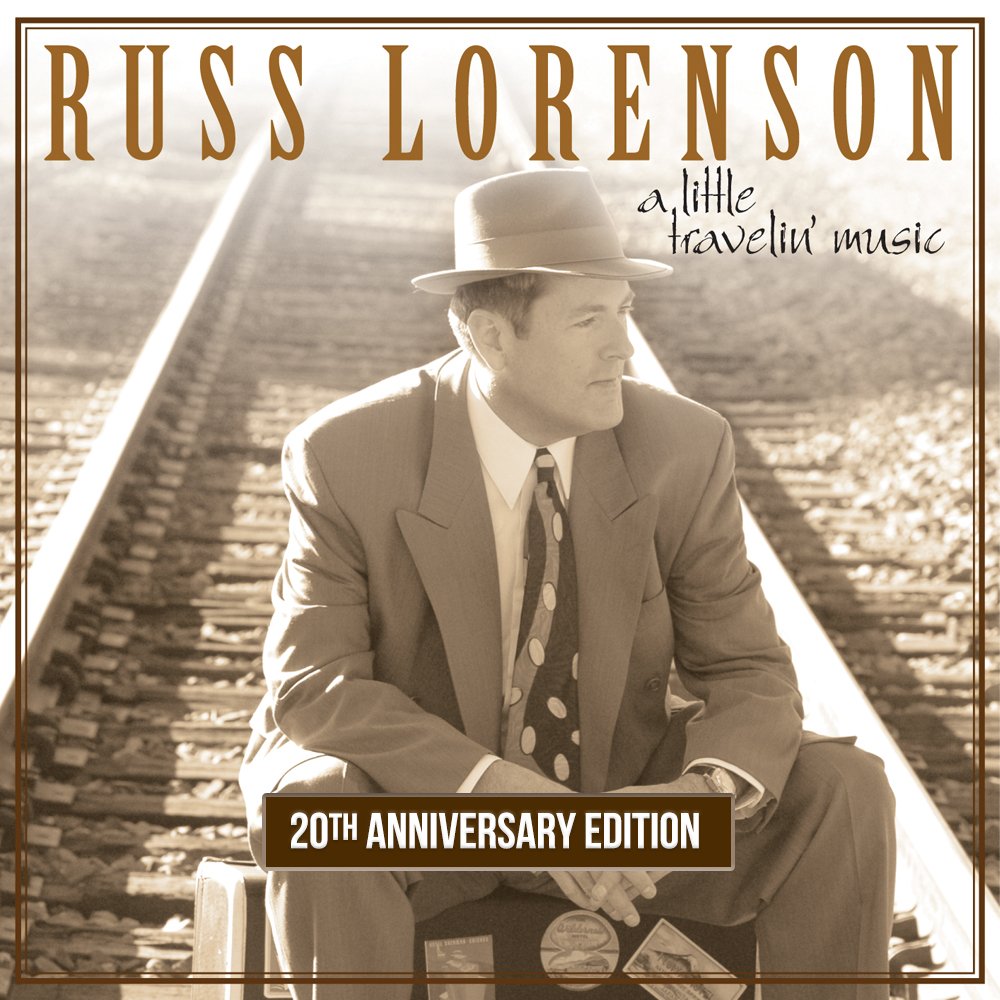
That’s what Russ Lorenson learned from the 20th anniversary reissue of his 2006 debut album, A Little Travelin’ Music.
For the uninitiated, Russ Lorenson has spent the past two decades establishing himself as a prominent interpreter of the Great American Songbook. Having performed with some big names like Eartha Kitt and Andrea Marcovicci, he’s made it his mission to keep classic standards alive and thriving in the 21st century, and fortunately, he has the voice for it.
A three-time MAC Award nominee, Lorenson has been performing in some capacity since his early school years, showing a talent for styles that involve dynamic performances and a high level of technical skills. He began his career in musical theatre and cabaret before pivoting to jazz and turning his focus to the Great American Songbook. He took to singing in nightclubs in the early 2000s, and by 2006, he released the first incarnation of A Little Travelin’ Music. Now, 20 years later, he’s decided to breathe new life into it.
In his own comments on the album, Lorenson notes that the 2026 version of A Little Travelin’ Music isn’t just a remastering of the old recordings. For him, it’s been a labor of love. In his own words, “Rather than simply remastering the recording, I revisited the original masters and selectively rebuilt parts of the album, including newly recorded passages, to reflect twenty years of artistic perspective.”
The process raised several questions for Lorenson. Quoting again, “What survives after 20 years? What proves essential, what merits refinement, and what must evolve in order for the music to remain contemporary while honoring its original spirit?” In short, Lorenson needed to uncover what truly makes a piece of music timeless. Who better to answer that question that someone well-versed in the Great American Songbook, the past century’s most lasting and resonant catalogue of music?
Having listened to both version of the album, there are clear differences. Many tracks on the 2026 version feature fuller, more robust arrangements than their older counterparts, which lacked the benefit of 2020s recording equipment. Some of the basic mechanics of the album are different, too. He chose to draw listeners in with his blended rendition of “Come Fly with Me / Let’s Get Away from it All” rather than “When in Rome,” letting the pair of sweeping classics introduce his themes of romance and world travel. He axed a couple of tracks from the new version, including “Why Do the Wrong People Travel?,” “On a Slow Boat to China,” and “Katie Went to Haiti,” recognizing, perhaps, that their themes of class commentary, exoticism, and implied sex tourism (arguably) might not strike the same way in the world-weary landscape of the 2020s. Finally, instead of “Christmas in San Francisco,” he chose to end with “I Left My Heart in San Francisco,” an earnest love letter to the city that shaped his early life and career.
But Lorenson also made some bold choices in determining what he would keep after 20 years. Notably, he retained his nine-minute musical tribute to romance in London, which includes both “A Foggy Day in London Town” and “A Nightingale Sang in Berkeley Square.” In today’s streaming economy, it’s rare and refreshing to see a track of this length. Lorenson himself calls it “commercially impractical” – and for that reason he also provided a shorter radio edit – but he was willing to take that risk because above all things, he believes in what he is doing.
You can feel Lorenson’s passion for the Great American Songbook in his performance. He loves this music. He wants it to be treasured, and he knows the world needs to hear it now as much as ever. Best of all, he seems to have been born for the role of a classic American crooner. Lord knows he has the charisma, but he also has the voice. Jazz singing is not easy. In fact, I’d say it’s one of the most sophisticated and technically demanding genres a vocalist can choose. Lorenson makes it seem easy. Velvety-rich and smooth like a cup of coffee, his voice is easy to get lost in, and it makes him the perfect candidate to bring this music to life in the 21st century.
As for the subject matter, Lorenson has some authority on that, too. Before committing himself to music, he held a corporate job in the tech sector which often sent him on business trips around the world. It was that experience that inspired him to center his debut album around the theme of travel.
Every song on the album is rooted in a place, or in the liminal spaces between places, and that’s part of what makes them so enduringly meaningful. Places hold strong emotional connotations. They bring feelings of yearning, romantic dreaming, and attachment. Much of the music on the album was written before Russ Lorenson was even born, but the idea of travel is something he understands. He colors each piece with his own particular perspective.
There’s a reason why the tradition of the Great American Songbook has lasted so long (and shows no signs of slowing down). The music is timeless. Sometimes timelessness means a thing can remain the same for centuries and never lose its bite, but other times it means a thing can be adapted and take on a new meaning for a new world. For example, the song “Gay Paree” (track 9) is still a joy to listen to, but the affectionate innuendo might not sound quite as scandalous to 2026 ears as it did in the 1960s. That’s exactly why Lorenson is so committed to keeping this music alive. He’s showing us that it still has relevance in the 21st century, that it can grow and redefine itself with time, and he’s giving us an opportunity to hear beloved classics in a way we never have before.
On a personal note, “Moonlight in Vermont” (track 4) is a song I never get tired of hearing. I spent three years living in Vermont, and I’m planning a honeymoon there later this month, so suffice to say, it’s a song with special meaning for me. I’ve heard it a million different ways, but I’ve never heard it the way Russ Lorenson does it. For that matter, I’ve never heard any of these songs the way Russ Lorenson does them. I’ve heard Frank Sinatra, Bobby Darin, Blossom Dearie, and Glenn Miller a thousand times, and I’ve loved their renditions in a million different ways. But thanks to Russ Lorenson and his steadfast commitment to rereleasing his music, I get to hear these tracks translated into 2026.
A Little Travelin’ Music is not a rehashing of songs everyone knows. It’s a curated sampling of the Great American Songbook, handpicked and updated for the year 2026. Treasure it. It’s a rare opportunity to hear your old favorites for the first time again.
KEEP UP WITH RUSS LORENSON BELOW: